
Safety Standards: Dive Courses Vs Fun Dives:
How The Dive Safety Framework Changes
Dive Training agency standards apply strictly while you're working toward a certification. But once you're certified and booking a recreational "fun" dive, those same standards don't automatically carry over. Instead, you're operating under each dive centre's own safety policies, local maritime law, and your own judgement. Here's what actually changes, what a genuinely good dive centre does to fill that gap, and the questions worth asking before you ever get in the water.
Dive Training Standards: What Applies During a Course
When you're undertaking a recreational scuba diving course or certification with a dive centre, under the guidance and supervision of a certified and authorised diving instructor, key safety rules and requirements apply reflecting the training agency's own standards and guidelines. These are documented, published, and accessible through the relevant training agency's website, and typically cover:
Entry and certification requirements
Instructor/student ratios
Maximum depth limits
Safe diving practices
Medical declarations
Pre-dive briefings
Equipment and maintenance procedures
Emergency action plans
A dive centre is obliged to apply the training agency's safety standards throughout the delivery of a course and may document their own policies reflecting this demonstrating a clear signal of their commitment to students. But it's important to understand that beyond training, these same standards don't directly apply to the recreational "fun" dives the same centre offers certified divers.
Beyond Certification: How the Safety Framework Shifts
While training agencies set their global educational and safety standards, they don't manage day-to-day dive operations. Once you're certified and sign up for a dive trip, your dives are managed under the local dive centre's own operational safety policies and code of conduct and bound by applicable local and maritime law, not agency course standards.
In my experience, dive centres will typically ask three questions when you book a dive: your certification level, number of dives completed, and date of your last dive. Many will ask further questions to gauge your capability against local sites and conditions. As a certified diver, it's just as much your responsibility to know about the dive sites, the centre, and their approach to safety. Never hesitate to ask questions and feel genuinely comfortable before committing to a trip.
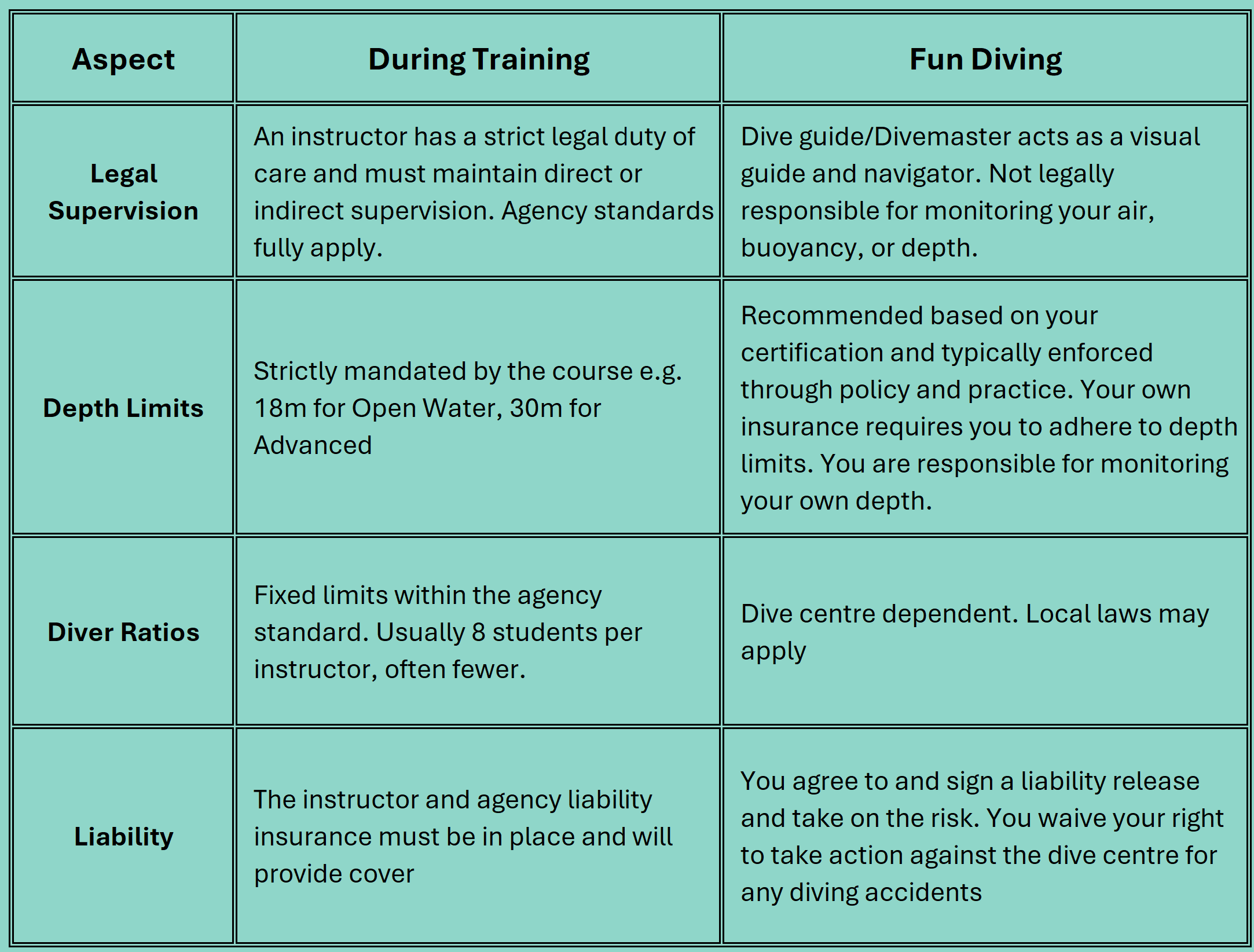
The biggest hurdle for newly certified divers is the sudden shift in responsibility. During training, students get used to an instructor constantly monitoring, supervising, and correcting their actions where needed. Once certified, that relationship changes completely.
You're now a certified diver and responsible for your own safety. Your buddy, or dive guide, is not responsible for your decisions and actions during the dive. Understanding the shift from supervised student to independently responsible diver is critical to staying safe.
This table shows how the safety framework and policies actually shift once you move from student to certified diver:
This transition is genuinely challenging, because new divers often lack the experience to self-evaluate their own capability against the conditions at a given site. A newer diver may struggle to identify or react to unexpected scenarios such as a stronger-than-expected current. Buoyancy control and air management still need perfecting; the theory may be well understood from your training, but the practical experience takes longer to build. Your post-certification dives are also likely to happen in new environments, sometimes more demanding than anything you've dived before.
Being prepared depends heavily on the relationship you build with your dive buddy or dive centre and dive guide. A good one will set your expectations clearly about the conditions you'll encounter and provide guidance that you understand and feel confident in applying.
This is your best chance to manage an unexpected scenario before it becomes an incident and avoid a panic situation. If that information isn't offered to you, ask for it - I’ll share with you how.
What to Expect From a Good Dive Centre
Since training agency standards don't carry over directly to fun dives, it's the dive centre's own safety culture that fills the gap, and a genuinely good one makes this visible, not something you have to dig for.
Look for operators who:
Check your certification card and logged dive history before taking you out, not just your booking confirmation
Carry appropriate emergency equipment on every boat including oxygen, a first aid kit, and a clear emergency action plan the whole team knows.
Brief every dive properly before you get in the water, covering entry and exit points, expected depth and time, topography, currents, and the plan if something doesn't go as expected
Assign sensible buddy pairings and guide-to-diver ratios based on the site's actual conditions, not just whoever happens to be available that day
Maintain a clear, written safety policy they're genuinely happy to share if you ask
Encourage divers to ask questions
None of this needs to feel like an interrogation. A dive centre that takes safety seriously will usually offer most of this information before asking for it. If they don't, that tells you something worth knowing too.
My Tips for Everyone
Irrespective of your experience level, years since you certified, specialties held, or dives logged, always be confident to ask questions and make sure your dive is safe and enjoyable. I'm an experienced diver, and there's no shame in asking questions when planning a dive or at the pre-dive briefing. Here are my go-to questions, if they're not already answered during the briefing:
How deep are we expecting to dive?
What's the topography - reef, wall/drop-off, slope, or sandy bottom?
What current do we expect to encounter?
What hazards may be present - sharp rocks / objects, harmful marine life e.g. Scorpion / Stonefish, Fire Coral
If we do hit unexpected current, what's the plan to deal with it?
What's the guide-to-diver ratio, and how many divers are in the group?
Who's buddying who?
Frequently Asked Questions
Do training agencies standards apply to fun dives after certification? No — agency standards apply specifically to training and certification courses. Once certified, your fun dives are governed by the dive centre's own operational safety policies and local maritime law instead.
Who is responsible for my safety on a fun dive? You are. Your dive guide or Divemaster acts as a visual guide and navigator, but is not legally responsible for monitoring your air, buoyancy, or depth — that responsibility sits with you as a certified diver.
What should a good dive centre's safety briefing include? Entry and exit points, expected depth and dive time, site topography, anticipated currents, and a clear plan for handling anything unexpected — along with sensible buddy pairings based on the group's experience and the site's conditions.
What should I ask before a dive if it isn't covered in the briefing? Expected depth, topography, anticipated current and the contingency plan for it, the guide-to-diver ratio, and who you're buddied with — all fair, normal questions to ask any dive centre.